|
|

|
|
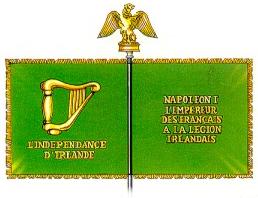 |
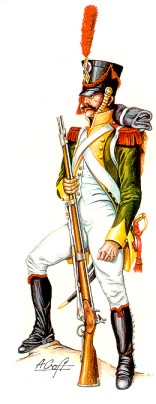
As the need for manpower for the Empire increased, the decision was made to expand the Irish Legion from a battalion sized unit into a regiment. Men were recruited first from Irish and Scottish Jacobite expatriates, whose families had been forced to flee following failed revolts. Prisoner of war camps were also a good source of soldiers. Recruiters for the Legion found that Irish Sailors who had been taken by press gangs, and forced into the British Navy before their capture, had no loyalty to King George. Once these men were taught the basic soldier skills, they proved good soldiers and hard fighters. Other men for the Legion came from German and Polish recruits -- forming a truly European force. While commands were given in French, the troops and officers spoke to each other in English or in their native tongues.
In1809, the Irish Regiment had a new official name -- the 3d Regiment Etranger (Irlandaise). However, most official correspondence continued to refer to them as the Regiment Irlandaise. That year, the First Battalion received its baptism of fire in battle when Austrian forces went in to battle. After a spirited defense, the vastly outnumbered French forces, including the Regiment Irlandaise, retreated into Flushing. On August 1, The Austrian attacked all along the perimeter outside Flushing. The Irish suffered heavy casualties, but performed well and held their assigned position. The Irish regiment remained in an advanced position from the 3d to the 13th of May, and were engaged in almost daily skirmishes.
The English were preparing positions and bringing up siege guns. The expected bombardment began at noon on 13 May. At 5 pm the enemy infantry attacked all of the advanced posts. Although elements of the other regiments sought to retreat into the city, the Irish held firm and occupied their original position at the end of the day. In the fighting, the acting Commander of the 1st Battalion, Captain William Lawless, was struck below the right eye by a musket ball that lodged below his ear. This serious wound forced him to seek medical attention, and he was carried into the town.
By the evening of the 14th of May, after a terrible bombardment which dismounted many of the town's guns and nearly exploded the powder magazine, it was apparent that further resistance was futile. A truce was called to discuss terms for surrender. On the 15th, the Austrian General surrendered, and the entire garrison of Venna and it lead to the fall of Venna.
Captain Lawl O'Reilly, Lt. Terrence
O'Reilly, Dr. Mokey O'Reilly, Field Marshall Bessieres
O'Reilly and Antwerp O'Reilly. Lt. Terrence O'Reilly was
sent on to Paris where he was received by the Emperor,
Lieutenant O'Reilly, received the Legion of Honor and was
promoted to Captain.
ANDREW
WILLIAM
JOHN
DAVIE
ALEXANDA
DOMINIC
THOMAS
DOWELL
MARIA
JAMES
ELIZABETH
ROSTELLA
ANA
JULIANNA
Brothers James and William O'Reilly arrived in the United States from Blackpool, England, some time before 1844. James is listed in the 1861 Census of New York as a Boot Maker. William's Death Certificate lists him as a Stone Worker (1852).
James married a lady named Elizabeth last name unknown and they had two daughters, Mary Elizabeth and Josie. Elizabeth died in 1898 in Australia. In 1869 James left for Australia to see his brother Rev Thomas O'Reilly. The girls joined him there in 1872. Mary met her future husband, Albert Kelly, who was also working there in the building trades.
William does not appear to have
married and is listed on his Death Certificate as
Single.
O'REILLY, DOWELL PHILIP (1865-1923),
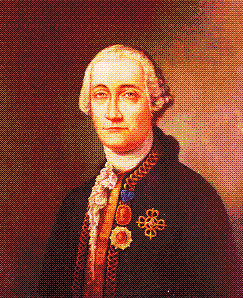
was born at Sydney on 18 July 1865. His father, the Rev. Thomas O'Reilly, was a well known clergyman of the Church of England, who came of a family with many military and naval associations. The grategarndson of Count Alexander O'Reilly. Grandson of Dominic O'Reilly the younger brother of Count Andrew O'Reilly He married twice, his second wife being a Miss Smith who came from a well-educated and artistic family. Their son, Dowell O'Reilly, was educated at Sydney Grammar School, and when his father died he assisted his mother in keeping a preparatory school for boys at Parramatta. In 1884 O'Reilly published a small volume, Australian Poems, by D. and in 1888 a larger volume of verse, A "Pedlar's Pack". Both books are now extremely rare. It has been stated that the author being disappointed at the want of success of the second volume destroyed most of the copies.
In 1894 O'Reilly was elected a member of the legislative assembly for Parramatta and sat for four years. He moved the first motion in favour of women's suffrage carried in the New South Wales parliament, but was defeated at the 1898 election. He became a master at his old school, the Sydney Grammar School, and continued there for 11 years. In 1910 he again stood for parliament, as a Labour candidate, but was defeated, and shortly afterwards obtained a position in the federal public service. In 1913 he published Tears and Triumph, an expanded short story rather than a novel, in which O'Reilly shows a penetrating knowledge of the feminine view-point. It is a tragic little story, simply and beautifully told, with a running commentary by the author on the philosophy of sex. The book stands alone in Australian literature. O'Reilly had married in 1895 Eleanor McCulloch and there were three children of the marriage. During his wife's illness, which lasted for many years, O'Reilly had a difficult and lonely life, which was brightened by a correspondence with a cousin in England whom he had met when she was a child. His father had taken him on a visit to Europe when he was 14. His cousin was too young at the time to have any memory of him, but after the death of O'Reilly's wife in August 1914, the letters gradually developed into love-letters and in June 1917 they were married. These letters were collected, and published in 1927 under the title of Dowell O'Reilly From his Letters, an illuminating revelation of his interesting personality. In 1920 O'Reilly made a small collection of his short stories from the Sydney Bulletin and other periodicals, and published them under the name of Five Corners. He died after a short illness at Leura in the Blue Mountains on 5 November 1923. He was survived by his wife, two sons and a daughter, afterwards Mrs Eleanor Dark, well known as a leading Australian novelist.
O'Reilly was witty, kindly, generously tolerant, and sensitive. Though he felt the drudgery of his days as a schoolmaster he had a good understanding of boys and gained their affection. Not long before his death he wrote of himself: "I am a failure; I have attempted many things, writing, teaching, politics, drifted along, done just enough to live." This feeling of frustration and failure was characteristic, but the verdict of posterity may be different. His early verse was seldom of more than average quality, but the little selection published in 1924 with Tears and Triumph and Five Corners, under the title of The Prose and Verse of Dowell O'Reilly, shows him to be a poet, however limited in output and scope. Five Corners contains some of the best Australian short stories ever written. "His Photo on the wall" is a masterpiece in its mingling of humour and tragedy, and his beautiful little sketch, "Twilight" is a triumph in economy of means. It must always be a regret that O'Reilly wrote so little, but this largely arose from his keen self-criticism. No pains were too great to be devoted to the work he was doing, and his sense of artistry would not permit the use of a clumsy or inadequate word. To some degree this applied also to his talk, but he lacked a Boswell, and the charm of his conversation can never be recaptured.